


Dream Pen Tsuikin Kanhizakura
Dream Pen Tsuikin Kanhizakura
Couldn't load pickup availability
Description
Description
Note:
- The Tsuikin art does not require any polishing steps. Therefore, sometimes it might leave the surface with a few uneven dots. *Please do not mistake these as defects.*
- The hand-making process makes every single pen a unique one, there is no pen exactly resembling one another. The one you will receive might be slightly different from the one here in the pictures, yet this characteristic makes each pen a unique work of art, with no two pieces exactly the same.
A brief history of Okinawa
The Ryukyu Islands first appeared in the ancient Chinese history book entitled "Sui Shu” around 607. After almost one and a half decades of going through the Chinese tributary system, two dynasties, and the Satsuma invasion, Ryukyu Kingdom was demolished by Meiji Government in 1879, and Okinawa prefecture was born. Yet again, when the Pacific War ended in 1945, Okinawa was once again parted from Japan as the U.S. limitary remained under their governance for the following 27 years. On May 15, 1972, Okinawa was officially returned to Japan, marking a new milestone in both Okinawa and Japan's history.
Ryukyu Kanhizakura
Among Japan's many varieties of cherry blossom, Okinawa has one most distinctive types. One of Okinawa's native cherry blossom varieties is the Ryukyu Kanhizakura. These flowers have a bell-like shape and their petals are a darker shade of pink.
The warmer winter in Okinawa brings the Kanhizakura to bloom in late January or February, and these trees thrive on mountainsides as opposed to the beachfronts.
The origin of Ryukyu Tsuikin art
Despite the complicated history, the culture and traditional crafts, especially lacquering, fortunately, have flourished, preserved, and continued until today. Old documents record that Okinawan lacquerware appeared as soon as 1427, with a purchase record from Emperor Xuanzong of the Ming Dynasty. After the establishment of the First Ryukyu Dynasty (1429), the Kaizuri Bugyosho (a magistrate's office for lacquerware production) was founded.
In Okinawa, where politics and culture are deeply connected, lacquerware and lacquer ornaments were indispensable for ceremonies and rituals, not only for royalties and warrior families but also for local communities. Especially, after the invasion by the Satsuma Domain, the need for lacquerware increased as they needed to tribute to both the Tokugawa shogunate and Chinese emperors. Therefore, the Ryukyu Kingdom put the Kaizuri Bugyosho under its direct control to strengthen lacquerware production.
During this period - the highest peak of Ryukyu lacquer, Ryukyu governors even sent craftsmen to China several times and brought in various lacquering techniques. One of those craftsmen - Higa Josho has developed the Okinawan-own technique - Tsuikin.
How Tsuikin art was made
“Tsuikin" involves many processes and requires a high level of skill. First, pigments are kneaded into lacquer to make "Tsuikin-mochi," which is shaped like a rice cake. Next, the Tsuikin-mochi is rolled out thinly on a board using a roller to cut out a pattern to be pasted on a vessel. In addition, fine lines are chiseled on the pasted pattern, which is then colored last. Highly adhesive, the finish can last for a long time.
Specifications
Material & art: Ebonite, Red Urushi, Tsuikin Urushi
Filling mechanism: Converter or Cartridge (European International Standard)
Nib: #6 Jowo stainless steel, Wancher 18K gold, Shogun 18K
Feed: Plastic, ebonite black, ebonite red
Compact air-tight cap: Prevent dried-out ink problem

Size & Shape

Packaging
Traditional Japanese Wooden Box + Pen Kimono + Instructional Materials + Certificate + Converter + Cartridge
Duties & Taxes
Duties & Taxes
For international orders, customers are responsible for any sales tax, duties, brokerage fees, and / or other taxes imposed by the government of the destination country, in addition to the quoted or invoiced price.
Learn about Wancher's terms of service for our premium fountain pens and writing instruments. Find important information on purchases, warranties, and customer rights. Essential reading for all Wancher pen enthusiasts and collectors.


Ryukyu Kanhizakura


Kanhizakura, Okinawan Original
Among Japan's many varieties of cherry blossom, Okinawa has one most distinctive types. One of Okinawa's native cherry blossom varieties is the Ryukyu Kanhizakura. These flowers have a bell-like shape and their petals are a darker shade of pink.
The warmer winter in Okinawa brings the Kanhizakura to bloom in late January or February, and these trees thrive on mountainsides as opposed to the beachfronts.

Craftmanship of Okinawa
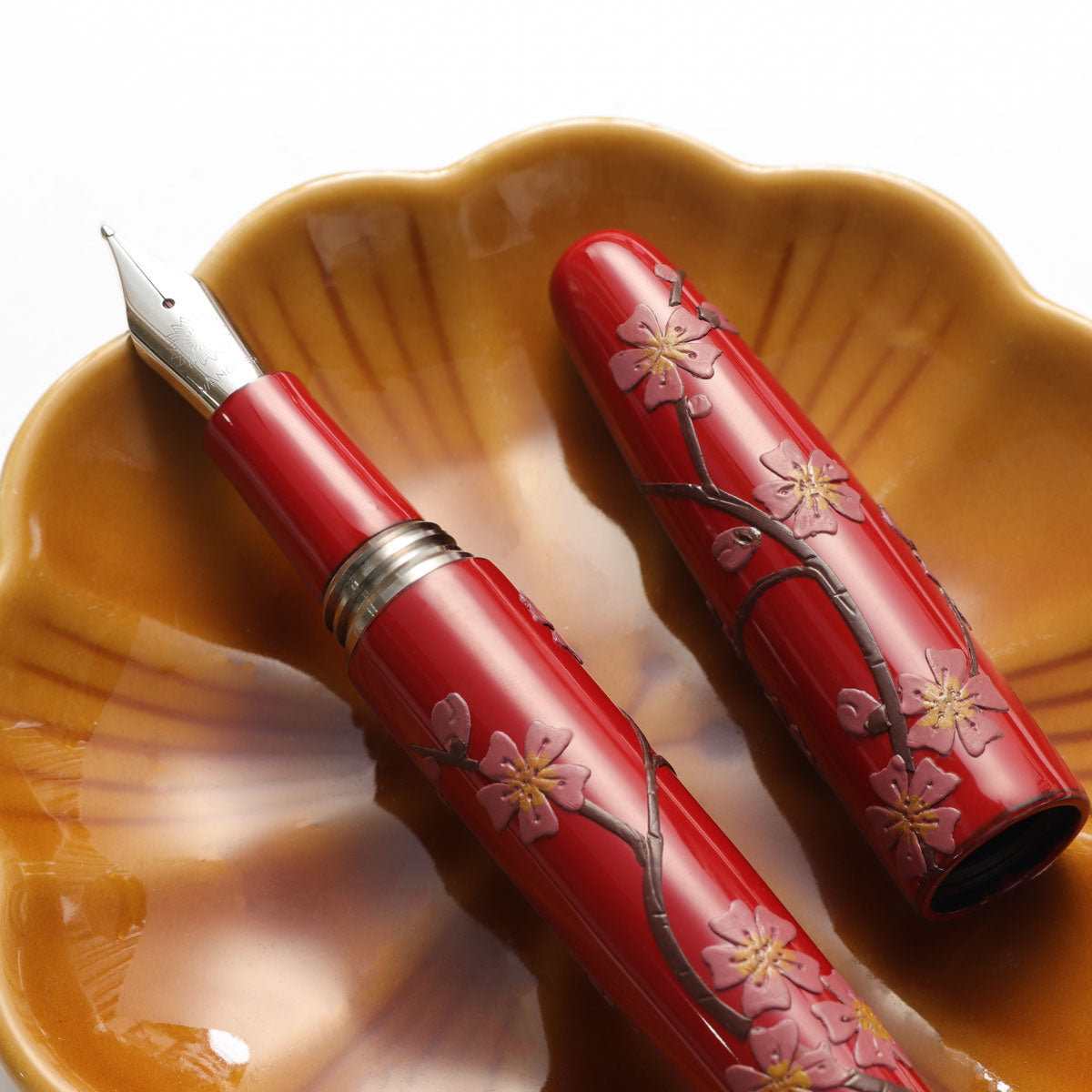
Unlike painted lacquer, Tsuikin creates sculptural motifs that rise gently above the surface, giving the blossoms remarkable depth and texture.
Layers of crimson Urushi create a rich backdrop, recalling the vibrant blossoms of the Ryukyu Kanhizakura.

Handcrafted
Each sakura petal is carefully handcrafted with Mochi, a pliable mixture of Urushi and natural pigments rolled into the flat sheet and each blossom and tree branches is individually shaped, cut, and delicately inlaid by hand.
Finally, the pen placed inside an Urushi-Furo (a curing container or cabinet) with a high humidity to mature over the course of several months. Unlike the fleeting petals of the Ryukyu Kanhizakura, these will be immortalized, and can forever be admired by anyone with an appreciation for art.


