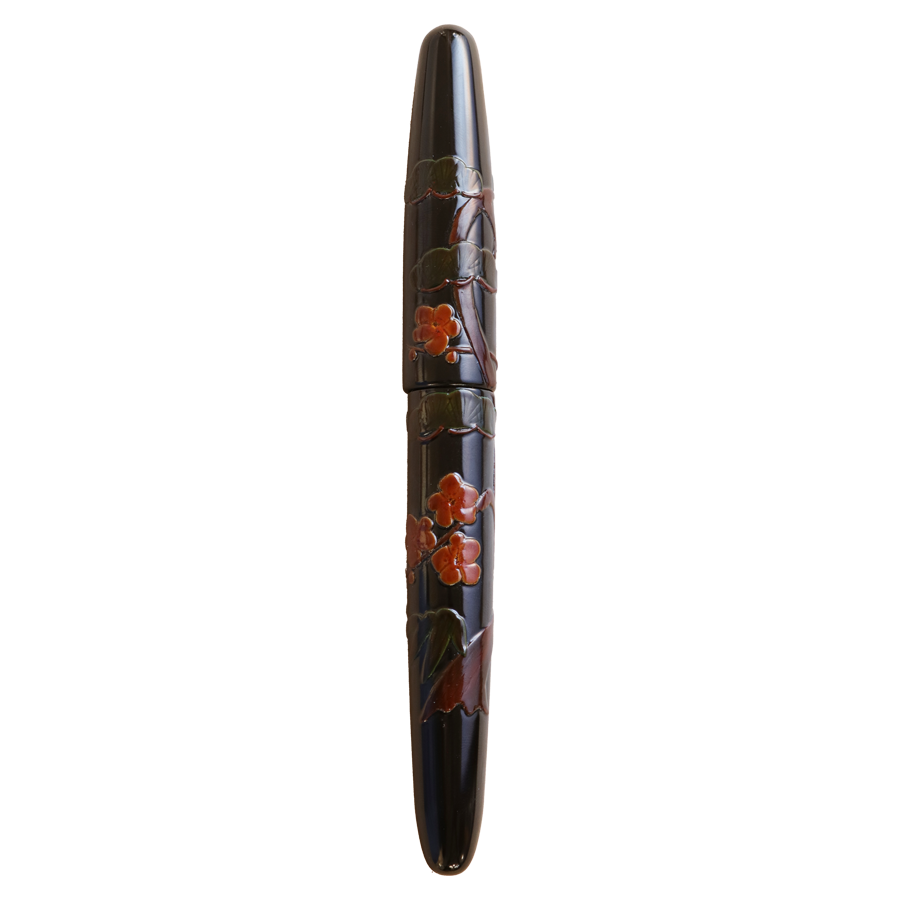
Ryukyu Tsuikin Bonsai Fountain Pen
Couldn't load pickup availability
Description
Description
A Keiryu Exclusive
This fountain pen is available with a free stainless steel Keiryu Nib, which has been customized by the Nib Shaper Yukio Nagahara. To upgrade to a Keiryu Kodachi, you only need to pay an additional 40 USD instead of the usual 90 USD. To learn more about the Keiryu and Keiryu Kodachi, please visit our page: Keiryu by The Nib Shaper.

Bonsai
The cultivation of the bonsai tree has parallels with the crafting and collection of fountain pens, as both are labors of love and passion. As each pen can represent their respective collector's state of mind, so too can the bonsai tree represent their owner's inner thoughts, begging the question of what the Dream Pen Tsuikin Bonsai Fountain Pen can say about who you are, and who you strive to be.
The deep black of the fountain pen is the perfect canvas for the delicate branches of the Bonsai Tree, wrapping around it like a comforting embrace. Bright green leaves adorn the branches. Pale pink flowers bloom on one branch and not the other, as if it is a lesson in restraint. This minimalist portrait of a bonsai tree on the fountain pen is crafted entirely from clay and Urushi (Japanese lacquer), elevating a treasured art form - raising bonsai trees - to another level entirely.
Like the historic bonsai trees that inspired the Master Artisans of Okinawa, each pen will be unique, and cannot be replicated exactly.
Tamesukashi
The Bonsai Tamesukashi adds an extra layer of Urushi, thereby heightening the complexity. Instead of coating the entire pen with transparent Urushi, the Master Artisans have used the highly-coveted Tamesukashi Technique, which was a Pre-Edo Period way of finishing katanas and their scabbards. The Tamesukashi technique uses an amber-colored, semi-translucent Urushi, and coats the pen so that it makes it appear that the bonsai tree has been encased forever within amber.
It transforms this spring or summery design into an autumn-themed tree, complete with dark orange petals, faded green leaves, and even darker branches.
The Origin of Ryukyu Tsuikin Art
Despite the complicated history, the culture and traditional crafts, especially lacquering, fortunately, have flourished, preserved, and continued until today. Old documents record that Okinawan lacquerware appeared as soon as 1427, with a purchase record from Emperor Xuanzong of the Ming Dynasty. After the establishment of the First Ryukyu Dynasty (1429), the Kaizuri Bugyosho (a magistrate's office for lacquerware production) was founded.
In Okinawa, where politics and culture are deeply connected, lacquerware and lacquer ornaments were indispensable for ceremonies and rituals, not only for royalties and warrior families but also for local communities. Especially, after the invasion by the Satsuma Domain, the need of lacquerware increases as they need to tribute to both the Tokugawa shogunate and Chinese emperors. Therefore, the Ryukyu Kingdom put the Kaizuri Bugyosho under its direct control to strengthen lacquerware production.
During this period - the highest peak of Ryukyu lacquer, Ryukyu governors even sent craftsmen to China several times and brought in various lacquering techniques. One of those craftsmen - Higa Josho has developed the Okinawan-own technique - Tsuikin.
How Tsuikin art was made
“Tsuikin" involves many processes and requires a high level of skill. First, pigments are kneaded into lacquer to make "Tsuikin-mochi," which is shaped like a rice cake. Next, the Tsuikin-mochi is rolled out thinly on a board using a roller to cut out a pattern to be pasted on a vessel. In addition, fine lines are chiseled on the pasted pattern, which is then colored last. Highly adhesive, the finish can last for a long time.
Specifications
Material & art: Ebonite, Tamesukashi (Aizu Urushi), Tsuikin Urushi
Filling mechanism: Converter or Cartridge (European International Standard)
Nib: Keiryu/Kodachi, or Jowo #6
Feed: Plastic, Ebonite (Ebonite feeds are only compatible with Jowo #6)
Compact air-tight cap: Prevents dried-out ink problem

Size & Shape

Packaging
Traditional Japanese Wooden Box + Pen Kimono + Instructional Materials + Certificate + Converter + Cartridge
Duties & Taxes
Duties & Taxes
For international orders, customers are responsible for any sales tax, duties, brokerage fees, and / or other taxes imposed by the government of the destination country, in addition to the quoted or invoiced price.
Learn about Wancher's terms of service for our premium fountain pens and writing instruments. Find important information on purchases, warranties, and customer rights. Essential reading for all Wancher pen enthusiasts and collectors.Share
