


"Light as a feather, smooth like butter, beautiful to look at. This is an exceptional writer and a piece of art, all in one."
Sekai Byakudan-nuri
Sekai Byakudan-nuri
Regular price
$600.00 USD
Regular price
Sale price
$600.00 USD
Unit price
per
Shipping calculated at checkout.
Couldn't load pickup availability
Description
Description
Important Note: The Byakudan-nuri on each fountain pen is handcrafted one by one. And this process might leave the final surface with an incomplete transition. Our artisans called it Wabi-sabi. It makes your fountain pen a unique piece of art that does not resemble any others. *Please do not mistake this with defects.*


What is Byakudan-nuri?
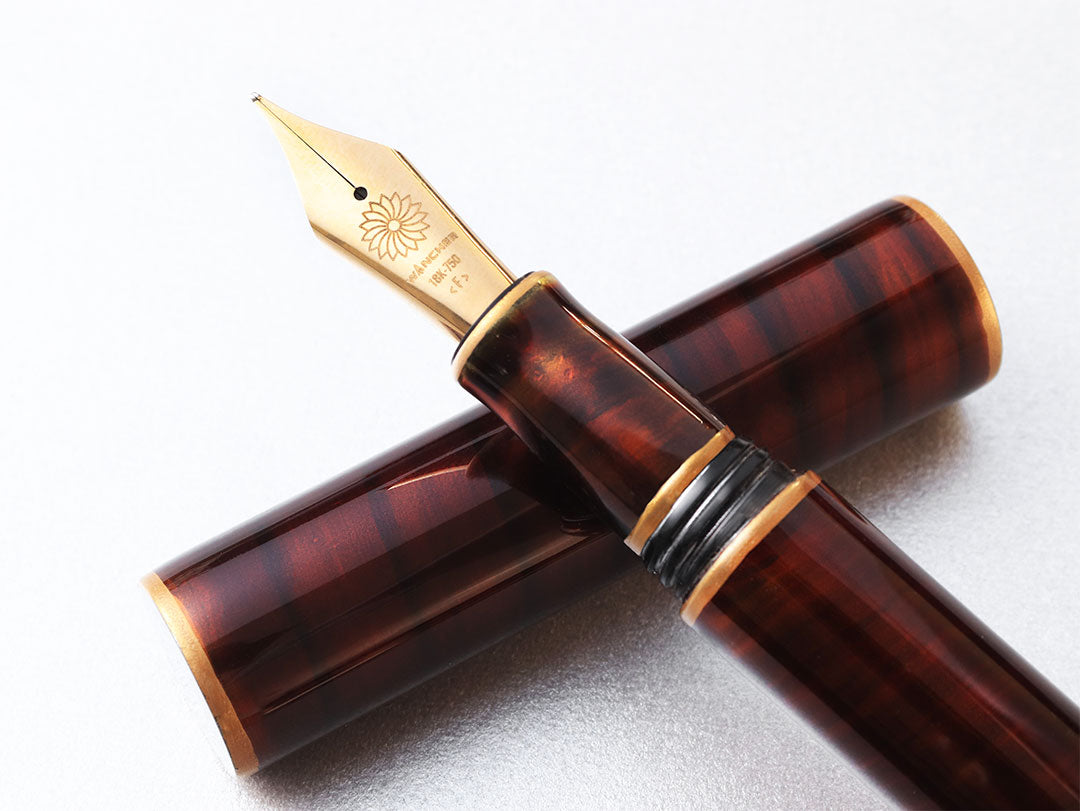
白檀 (Byakudan) translates as Sandalwood. It is said that this technique is named Byakudan-nuri because it resembled the amber color of Sandalwood.
A complicated process along with a meticulous handcraft is required to create a Byakudan-nuri artwork.
The first step is to apply a coating layer as a base, then an immediate Urushi layer is painted on top and swiftly, but surely sharpened smooth.
Afterward, paper-thin gold or silver foil is pressed onto the surface of the object and then coated with a layer of Suki Urushi (transparent Urushi lacquer).
After it dries, other transparent candy-colored Urushi layers will be applied.
The last, but also crucial step, is to polish the object until it's glossy.
To make the Urushi stand out on a pen body, each Urushi layer is coated in a spiral pattern. Therefore, the Byakudan-nuri looks like it is floating on the surface of the pen with a smooth transition of the brush lines throughout the pen.
This technique has not been seen on many writing instruments, which our fountain pen is proud to present.
Kintsugi art
In addition to the fastidious craftsman's work of Byakudan-nuri, the Kintsugi art was simultaneously applied to the edge of the pen. This is another aspect of the Japanese aesthetic sense where unnoticeable subtle elements are also the vital ones that aids to the total extraordinary craftsmanship.
Kintsugi 金継ぎ (or golden joinery) refers to the Japanese art of using Urushi with a metal powder such as gold and silver to mend broken pottery. A beauty in which emphasizes the beauty of 'scars', or the 'perfect imperfections'. On the edge of our fountain pen where the Byakudan coating ends, the Kintsugi is applied. It works as a connector of the whole pen body surface even though the cap, the grip, and the barrel are completely separate parts.

Specifications
Material & art: Wood, Urushi
Filling mechanism: Converter or Cartridge (European International Standard)
Nib: #6 Jowo stainless steel, Wancher 18K gold, Keiryu & Keiryu-Kodachi
Feed: Plastic, ebonite black, ebonite red
Size & Shape
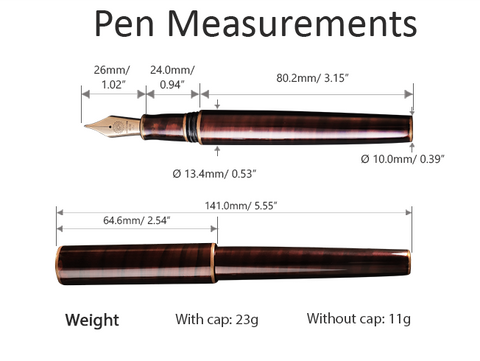
Packaging

Duties & Taxes
Duties & Taxes
For international orders, customers are responsible for any sales tax, duties, brokerage fees, and / or other taxes imposed by the government of the destination country, in addition to the quoted or invoiced price.
Learn about Wancher's terms of service for our premium fountain pens and writing instruments. Find important information on purchases, warranties, and customer rights. Essential reading for all Wancher pen enthusiasts and collectors.


Overall rating: 4.6 / 5 from 5 reviews.
AI Generated Review Summary
Summary topics
Review topics: [].
Review highlights
Reviews
beautiful and light . It
"beautiful and light . It fits to my small hand good."
"Beautiful pen! The lacquer is really nice and the nib is lovely. Thank you!"
Disappointed about the fountain pen quality
"I own two other Wancher fountain pens. And this purchase is not as good as the previous one. The fountain pen does not look as beautiful as the previous one."
a beautiful pen
"One of Wancher's most beautiful pens. Byakudan-nuri is layers of transparent reddish urushi over metal and colored urushi, in this case gold and black. The result is stunning, one of the most beautiful Wancher finishes I have seen. The kintsugi details on all corners (Sekai pens have a few more than the Dream pens), applying a thicker urushi and gold paste traditionally used to repair broken artifacts, complements the byakudan-nuri perfectly. A beauty! Mine has a red ebony feed which complements the finish, and a gold-plated 1.1mm stub, which, as expected, is very wet, with steady flow, and a smooth transit from thick to lean line. An exceptionally beautiful, great writer!"