


Quality of Finish
"I have returned the pen with 3 defects (broken leave skeleton) on one leave on the 05 Dec 2025 . Now awaiting to receive the replacement."
Couldn't load pickup availability
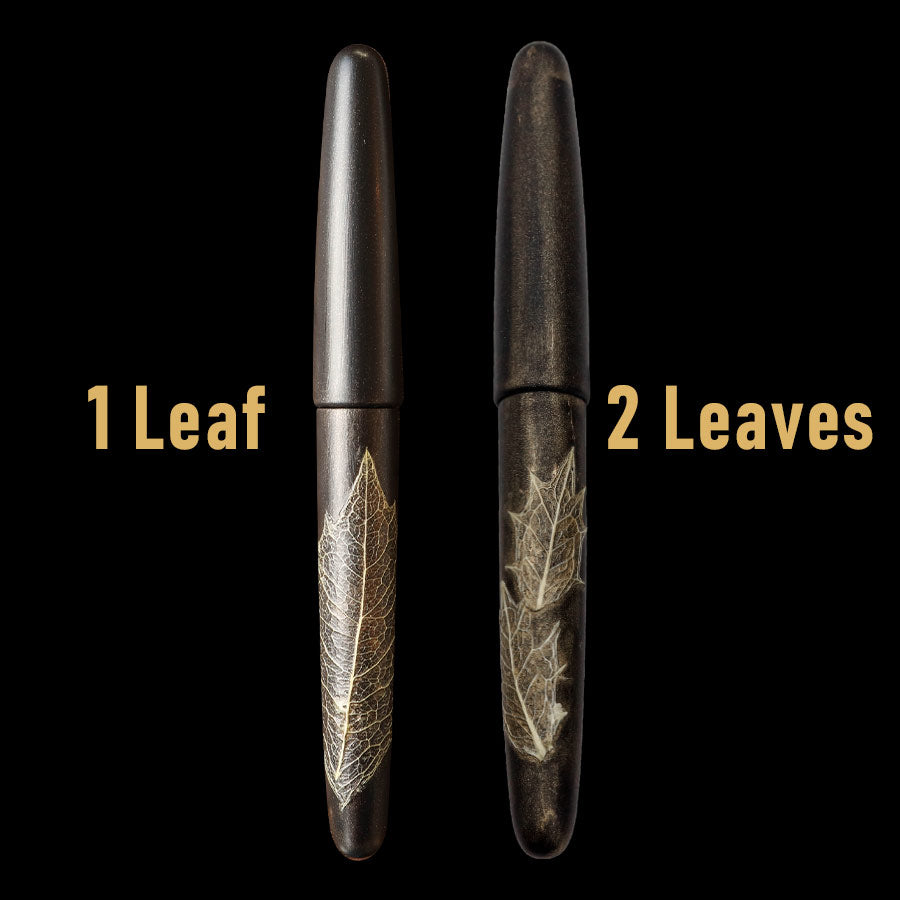
Note: Due to the unexpected changes of nature, the designs of the Kiei Nuri Series may change every season and every year.
"季映...四季の移り変わり、生命の美を映し出す.”
"When the season changes, you can see how nature blooms. That is the beauty of life."
The Kieinuri technique was a new lacquer Urushi art technique, originally invented and developed by our artisans at Wancher. It has taken us three years to complete the technique.
Inspired by the beauty of nature in Japan through four seasons, our artists depict the scenes of nature with the combination of Japanese natural leaves and natural Urushi (Shizen Urusen 自然漆). Hence the name of the technique 季映塗り、with 季 (“ki”) means seasons, 映 (“ei”) means reflection, and 塗り (“nuri”) means lacquering.
The concept of Kieinuri Urushi technique is enclosed with the message of the beauty of nature and the brightness of life.
We look at various trees while seasons change. The leaves change from pale color to green, then reddish-brown of autumn leaves and falling leaves.
Looking at the transition of each leaf during four seasons, we feel the breath of our life with strength and powerfulness.
Each leaf blooms and grows on the tree, as we need to live our life to the fullest.
With Kieinuri technique, after the lifetime of each leaf ends, its strength will not disappear, but will continue to live in the art, and deliver a meaningful message to the receiver of the art.
With the help of nature, Wancher is proud to present to you Kieinuri – Season Reflection technique.
The whole process is done by hand. Each pen and each piece of leaf is carefully selected and treated one by one by our artisans, as each leaf has its own character, and some are not qualified for the Kieinuri technique.
First, each leaf is completely steamed until it is completely dried. The artisan must check the leaves one by one during the steaming process, because the leaf may get too dried and become easy to break later.
Then, it is pounded one by one to achieve the best thickness.
In the meantime, we apply on the pen body with multiple layers of Urushi lacquer to reflect the scene of nature on the pen body.
Next, each leaf is dyed with Gold powder to have the Gold color, then attached to the body of each pen with transparent Urushi.
Finally, other multiple layers of Matt Urushi are applied. In order to honor the purest beauty of Japanese nature which has both smoothness and roughness, our artists keep the arts as natural as they are by applying Matt Urushi with Nuripanashi technique (the technique which does not require polishing step). The Matt Urushi also has the job of protecting the leaf as well. When you touch the body of each pen, you will feel the leaf as well as a naturally rough surface of Japanese Matt Urushi with some uneven dots.
*Please do not mistake this artistic purpose with defects.*

Material & art: Ebonite, Urushi
Filling mechanism: Converter or Cartridge (European International Standard)
Nib: #6 Jowo stainless steel, Wancher 18K gold
Feed: Plastic, ebonite black, ebonite red
Compact air-tight cap: Preven dried-out ink problem

Traditional Japanese Wooden Box + Pen Kimono + Instructional Materials + Authenticity Certificate + Converter + Cartridge

For international orders, customers are responsible for any sales tax, duties, brokerage fees, and / or other taxes imposed by the government of the destination country, in addition to the quoted or invoiced price.
Learn about Wancher's terms of service for our premium fountain pens and writing instruments. Find important information on purchases, warranties, and customer rights. Essential reading for all Wancher pen enthusiasts and collectors.


Overall rating: 3.75 / 5 from 4 reviews.
Review topics: [].
"I have returned the pen with 3 defects (broken leave skeleton) on one leave on the 05 Dec 2025 . Now awaiting to receive the replacement."
"I had problems getting this $1,400. 00 Golden Age fountain pen. When I ordered it online, the site stated that there were two in stock. However, I ordered the pen on 01. 26. 2025. I soon got an email that a pen had to be created for me, and besides, that there were delays applying the urushi because the weather wasn't humid enough; that it would take at least a month for the work to be completed. The pen finally arrived in the states, but it couldn't delivered because I had to fill out customs forms for FedEx, or the pen would be sent back to the vendor at his cost. The forms were complicated, even though they were in English, but they had terms whose meanings were beyond me. I called FedEx, and an agent helped me fill them out, sign them electronically, and email them back. The pen arrived the next day, 04. 10. 2025. It had the fine nib that I ordered, but when I inked it up it wrote like a double-broad nib. Soon after the pen arrived, I got a customs bill from FedEx for $85. 00. I reluctantly paid it. I don't know if the "tax" was an import tax, or was part of trump's tariff imposition. In any case, I'm unhappy. I've been using the pen regularly, and it now writes as a fine nib as it should. I like the Laban; the urushi is stunning, better looking than the picture, and I'm happy that I bought it, despite the hassle."
"A really beautiful pen with a sweet writing nib. Instantly one of my favorite pens in my small collection. It's elegant and I love it."
"This is a stunning pen. With the broad nib the write is perfect. It’s a good weight and the leaf is beautiful. Perfectly matched with Platinum Khaki black ink."