Ishime-nuri
Asama
Volcanic Power, Transformed by Urushi
Ishime-nuri
Asama
Volcanic Power, Transformed by Urushi
This collection will be Available from September 4th, 5 PM (JST)
Although there is a modern, scientific word for volcano in Japanese, for over a millennium, the Japanese people referred to volcanoes as Asama. Within this single word contains the full, complex relationship between mankind and the volcano, as it simultaneously expresses their awe of the volcano's destructive capability, as well as their inherent fear for their mortality.
Our inspiration
Japan is a land where people have long lived alongside the forces of the earth. Volcanoes rise from the land, reminding us of nature’s power while becoming an important part of the local landscape and culture.
In Shimane Prefecture, where Master Nagaya Momoko has helped revive the tradition of Yakumo Urushi Art, the close connection between people and nature inspired her to create this series of three fountain pens.
Each pen interprets a different stage and expression of volcanic activity, transforming the immense energy of the earth into a refined object designed to be held in the hand.
The first represents the crater, the dramatic opening through which a volcano reveals the power beneath the earth. The second depicts flowing lava, capturing the movement and intensity of molten rock as it travels across the landscape. The third draws inspiration from cooled volcanic rock, where the once-fiery force of the eruption has become solid, dark, and enduring.
Through Master Nagaya Momoko’s Ishime-nuri craftsmanship, the volcanic landscapes of Shimane are given a new form, preserving the character of fire, movement, stone, and time within each pen. What was once an immense force of nature is transformed into something intimate: a piece of volcanic inspiration that can be held in the hand and become part of our everyday writing.

What is
Ishime-nuri
Ishime-nuri (Stone Lacquer Technique) originated in Niigata Prefecture, and it was originally intended to mimic the texture of stone like those found in Japanese Zen Gardens. Although the pens remain smooth to the touch, there is a light, porous texture to the touch that feels comfortable, especially when in the midst of writing with a pen.
Master Nagaya achieves this unique look and sensation through the use of dried lacquer powder (Kanshitsu), which she creates by applying Urushi onto a glass plate and letting it dry before she peels it off. Afterwards, Master Nagaya grinds it into a fine powder by using a Yagen (薬研), which is an ancient version of a mortar-and-pestel, thus transforming Urushi into Kanshitsu. The Kanshitsu is applied onto the ebonite pen before the initial coating of Urushi (Japanese lacquer) has matured, and further polished by hand until Master Nagaya is satisfied with her art.
What is
Ishime-nuri

This technique requires precise control of the Urushi, Kanshitsu powder, and polishing process. The high viscosity of Urushi can cause the powder to clump, making a consistent texture difficult to achieve across the entire pen. Master Nagaya carefully hand-polishes each piece, constantly checking the surface to avoid over- or under-polishing.
Humidity must also be closely controlled throughout the process, as it affects the curing of the Urushi.
Although the Ishime-nuri process is one of the most complex techniques in Japanese Urushi Arts, its challenging nature plays a significant role in its beauty. Like the Stone Gardens of Japan's Edo Period, seeing and holding a pen made with Ishime-nuri instills calm and tranquility within.
Its uniqueness
Unlike traditional Ishime-nuri, Master Nagaya combines the Ishime-nuri and Byakudan-nuri techniques to create an expression uniquely her own. While much of her work is rooted in the Yakumo Urushi tradition, she continues to explore new possibilities by combining different Urushi techniques to create forms that have never been seen before.
The contrast between Ishime-nuri's matte, stone-like texture and the deep amber glow of Byakudan-nuri creates a striking impression of flowing lava, capturing the movement and energy of molten earth. Each pen takes at least 3–6 months to complete, with only a limited number produced in each batch.
What is
Ishime-nuri
Ishime-nuri (Stone Lacquer Technique) originated in Niigata Prefecture, and it was originally intended to mimic the texture of stone like those found in Japanese Zen Gardens. Although the pens remain smooth to the touch, there is a light, porous texture to the touch that feels comfortable, especially when in the midst of writing with a pen.
Master Nagaya achieves this unique look and sensation through the use of dried lacquer powder (Kanshitsu), which she creates by applying Urushi onto a glass plate and letting it dry before she peels it off. Afterwards, Master Nagaya grinds it into a fine powder by using a Yagen (薬研), which is an ancient version of a mortar-and-pestel, thus transforming Urushi into Kanshitsu. The Kanshitsu is applied onto the ebonite pen before the initial coating of Urushi (Japanese lacquer) has matured, and further polished by hand until Master Nagaya is satisfied with her art.

The difficulty of this technique lies in the timing and the chemistry. When the Kanshitsu powder comes into contact with the Urushi, it can easily clump, especially due to the naturally high viscosity of the lacquer, and maintaining a consistent texture throughout the entire Dream Pen is a significantly time consuming process. Since it is handpolished, Master Nagaya must constantly check to make sure she has not overpolished or underpolished, and she must continuously check the humidity levels inside her studio.
Although the Ishime-nuri process is one of the most complex techniques in Japanese Urushi Arts, its challenging nature plays a significant role in its beauty. Like the Stone Gardens of Japan's Edo Period, seeing and holding a pen made with Ishime-nuri instills calm and tranquility within.
Its uniqueness
Unlike traditional Ishime-nuri, Master Nagaya combines the Ishime-nuri and Byakudan-nuri techniques to create an expression uniquely her own. While much of her work is rooted in the Yakumo Urushi tradition, she continues to explore new possibilities by combining different Urushi techniques to create forms that have never been seen before.
The contrast between Ishime-nuri's matte, stone-like texture and the deep amber glow of Byakudan-nuri creates a striking impression of flowing lava, capturing the movement and energy of molten earth. Each pen takes at least 3–6 months to complete, with only a limited number produced in each batch.

Kakou
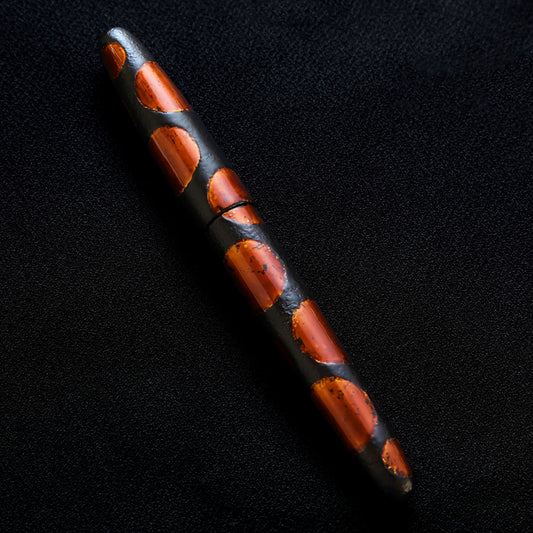
The Kakou depicts the fiersome beauty of the Japanese Volcano, featuring the black stone-texture Ishime-nuri finish interspersed with amber or dark red sections of Byakudan-nuri that glow as if they were pools of lava inside craters of volcanic rock. The contrast between the dark, hardened earth and the warm, translucent tones of Byakudan-nuri captures the moment when fire begins to become stone.
The Kakou Fountain Pen is a powerful yet refined reminder that even the most destructive forces of nature eventually become part of the landscape they have shaped.
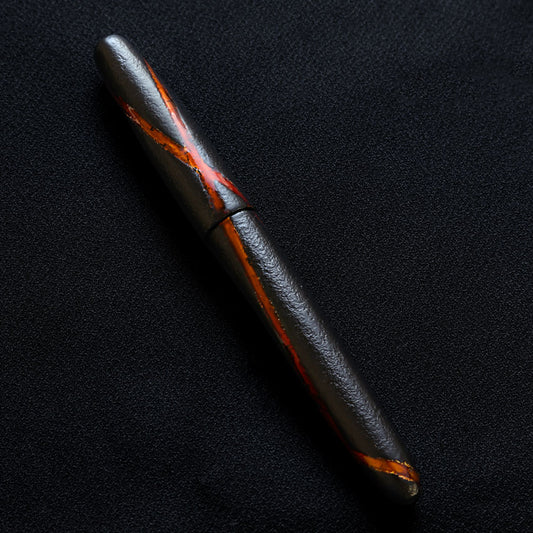
Yoganryu, meaning “Lava Flow,” captures the movement and energy of molten rock as it travels across the landscape. The smooth texture of the black Ishime-nuri is strategically sliced through with tendrils of a dark, amber color. Signifying the flow of lava down the side of a volcano, Master Nagaya uses the Byakudan-nuri Technique (Sandalwood Technique) to create an ethereal, burnished gold effect.
Its black Ishime-nuri foundation represents the dark, rugged earth, while flowing veins of amber Byakudan-nuri emerge across the surface like streams of incandescent lava glowing beneath the night sky. As with a volcanic landscape, no two patterns are exactly alike, giving each pen its own organic character. The interplay between the deep black Ishime texture and warm amber accents transforms the pen into a miniature landscape of fire and stone.
Yoganryu


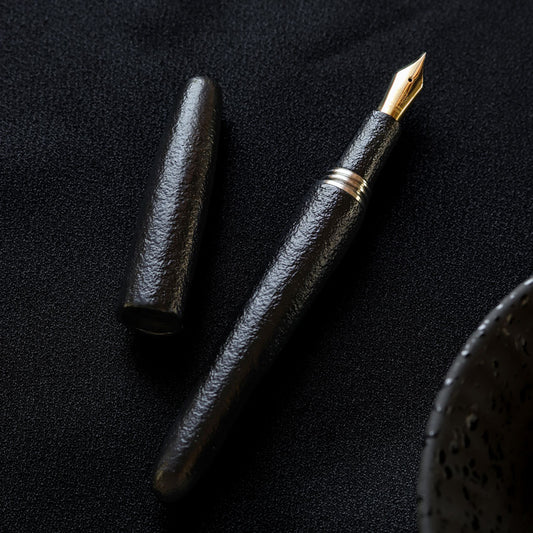
Kokuyougan embodies the quiet aftermath of volcanic activity. Its smooth black Ishime-nuri surface evokes dark basalt shaped and softened in appearance by time and the elements. This captures the darkness and permanence left behind once molten lava has cooled and hardened.
The subdued, tactile finish reflects the raw character of the earth while the refined form of the fountain pen represents the transformation of that natural force into something purposeful and enduring.
Although the pure black pen may seem stealthy from afar, having it in the palm of your hand reveals the complexity - both visually and physically - of its creation. Kokuyougan is a study in contrast: the immense power of the volcano expressed through the understated elegance of Japanese craftsmanship.
Kokuyougan
Kakou

The Kakou is the final stage of the fiersome beauty of the Japanese Volcano, featuring the black stone-texture Ishime-nuri finish interspersed with amber or dark red sections of Byakudan-nuri that glow as if they were pools of lava inside craters of volcanic rock. The contrast between the dark, hardened earth and the warm, translucent tones of Byakudan-nuri captures the moment when fire begins to become stone.
The Kakou Fountain Pen is a powerful yet refined reminder that even the most destructive forces of nature eventually become part of the landscape they have shaped. Through Master Nagaya Momoko’s craftsmanship, the raw textures and colors of the volcanic earth are transformed into a refined writing instrument, preserving the spirit of the volcano in a form that can be held and appreciated every day.
Yoganryu

Yoganryu, meaning “Lava Flow,” captures the movement and energy of molten rock as it travels across the landscape. The smooth texture of the black Ishime-nuri is strategically sliced through with tendrils of a dark, amber color. Signifying the flow of lava down the side of a volcano, Master Nagaya uses the Byakudan-nuri Technique (Sandalwood Technique) to create an ethereal, burnished gold effect.
Its black Ishime-nuri foundation represents the dark, rugged earth, while flowing veins of amber Byakudan-nuri emerge across the surface like streams of incandescent lava glowing beneath the night sky. As with a volcanic landscape, no two patterns are exactly alike, giving each pen its own organic character. The interplay between the deep black Ishime texture and warm amber accents transforms the pen into a miniature landscape of fire and stone.
Kokuyougan

Kokuyougan embodies the quiet aftermath of volcanic activity. Its smooth black Ishime-nuri surface evokes dark basalt shaped and softened in appearance by time and the elements. This captures the darkness and permanence left behind once molten lava has cooled and hardened.
The subdued, tactile finish reflects the raw character of the earth while the refined form of the fountain pen represents the transformation of that natural force into something purposeful and enduring. Although the pure black pen may seem stealthy from afar, having it in the palm of your hand reveals the complexity - both visually and physically - of its creation. Kokuyougan is a study in contrast: the immense power of the volcano expressed through the understated elegance of Japanese craftsmanship.
-
Ishime-nuri Asama - Kokuyougan
Regular price From $950.00 USDRegular priceUnit price per -

 Sold out
PRE-ORDER Delivery February 2027
Ishime-nuri Asama - YoganryuRegular price From $1,050.00 USDRegular priceUnit price per -

 Sold out
Ishime-nuri Asama - Kakou
Regular price From $1,150.00 USDRegular priceUnit price per