
-
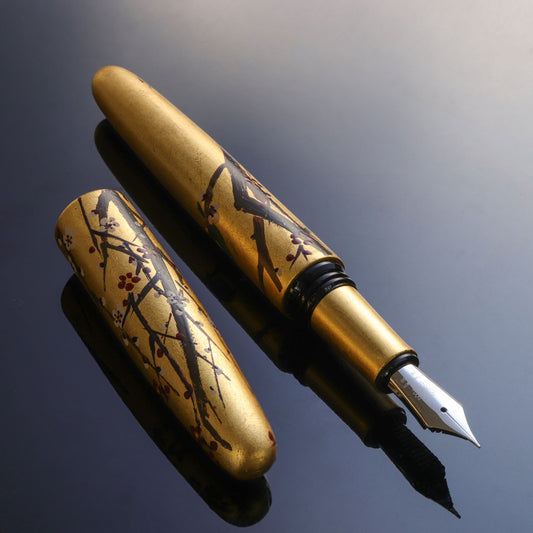
Hirota Byobu-e - Ume ni Hanasui (Plum Blossom)
Regular price From $2,950.00 USDRegular priceUnit price per -
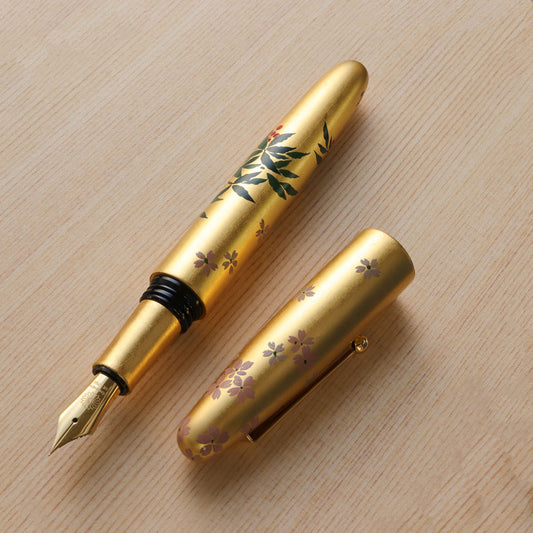
Hirota Byobu-e - Haru no Kotoboki (Celebration of Spring)
Regular price $2,950.00 USDRegular priceUnit price per


Hirota Byobu-e
Collector's Edition

About the Collection
This collector's edition honors Japan's gentle ever-changing season; when Spring renewal is captured with the blossoms, when Summer breeze soothes during the dawn, and when the resilient Camellia gracefully survives winter. First release will be at the end of March, followed by second release at the end of October.
The pen's is wrapped in layers of 24K gold leaf and hand-drawn using pigmented Urushi. Each pen comes with a Shogun 18K nib.
The Piece of History Retold
These masterpieces made complete by the artistry of Hirota Yoko. Her brush strokes on Byobu-e, was the one of the few artwork that cannot be replicated. Every details on the pen was intentional and drawn freehandedly, just as how Byobu-e painters in the past utilizes their highly developed brush techniques.
Byobu-e is the painting on Japanese folding screens (byōbu). These screens originally served as functional room dividers and windbreaks (the name literally means "protection from wind"), but they eventually became some of the most stunning canvases in Japanese art history. During Momoyama period (1573-1603), Urushi artisans paints freehandedly by relying on several brush technique to produce skillful details on large scale screen painting.


Each design is created as a singular piece — only one pen exists for each design.
First Release
梅に花吸
Ume ni Hanasui
(Plum Blossom’s First Breath)
Inspired by the resilience of plum blossoms, which bloom at the threshold of spring, this is the moment of quiet vitality as when life returns subtly, carried in the faint fragrance of blossoms.
春の寿ぎ
Haru no Kotoboki
(Celebration of Spring)
When light gathers softly, and the season begins to smile,Mother nature welcoming spring as a season of renewal, prosperity, and quiet celebration. Manryou or known as Christmast Berry are used for a celebration purpose, since they are known as a fortune bringing plant.
Hedera (Ivy)
The very captivating feature of Ivy is its young leaves always reach upwards, while the older leaves gracefully cascade downwards. Ivy, renowned for its resilience, embodies an unwavering spirit as its leaves persistently grow and expand, defying withering. The young leaves of ivy always reach upwards, while the older leaves gracefully cascade downwards.
In this life, it is of paramount importance to constantly improve oneself, regardless of the circumstances. Just like the Ivy plant that ceaselessly seeks opportunities to grow, Master Hirota found inspiration in its ability to adapt and flourish, even in the most challenging environments.
By incorporating the Ivy design into her fountain pen, she imparts a profound message. It serves as a poignant reminder that growth and personal development should be pursued relentlessly, overcoming obstacles with unwavering determination. The Ivy's journey becomes a powerful metaphor for the human spirit's unyielding quest for self-improvement and resilience in the face of adversity.
Tsubaki (Camellia)
As Master Hirota observes the cyclical nature of the Camellia flower in her garden, she reflects on its unique characteristics and imparts her wisdom. She explains that the Tsubaki flower, even in its withered state, possesses an unwavering determination. The Tsubaki, she elaborates, chooses to wither when it decides to and remains in full bloom when it so desires. This ability to assert its own lifecycle showcases the flower's innate autonomy and self-awareness.
The excellence of the Tsubaki is unassuming, marked by its noble and dignified appearance, yet it remains humble in its demeanor. This essence is beautifully captured by the Japanese saying "Hikaemena Subarashisa" (控えめな素晴らしさ), which encapsulates the concept of low-key excellence. The Camellia flower epitomizes this notion, exuding magnificence without ostentation.
In Master Hirota's Kinpaku Maki-e fountain pen, the beauty of the Tsubaki is immortalized. The design embodies the qualities of humility, determination, and unpretentious elegance that the Camellia flower embodies. Through the intricacies of the Maki-e technique, the pen serves as a tangible representation of the Tsubaki's essence, capturing its inherent grace and understated allure.
With every stroke of the pen, the essence of the Tsubaki flower is brought to life, allowing the beholder to experience its unique blend of determination, unpretentious beauty, and humble nobility.
Second Release
Coming Soon
Historical Background
The tradition began when screens were imported from China during the Nara period (8th century). By the Momoyama and Edo periods, they evolved into massive, gold-leafed masterpieces used to decorate the castles of shoguns and samurai. Famous schools like the Kano and Rimpa schools are well-known for their iconic Byobu-e designs featuring nature, seasons, and literature.